Sometimes knowing why isn’t enough to change how it feels
You may understand why you feel anxious, why a particular situation affects you, or where a pattern began – and yet still find yourself having the same emotional or physical response.
EFT Tapping offers another way of working with what you’re experiencing.
What is EFT Tapping?
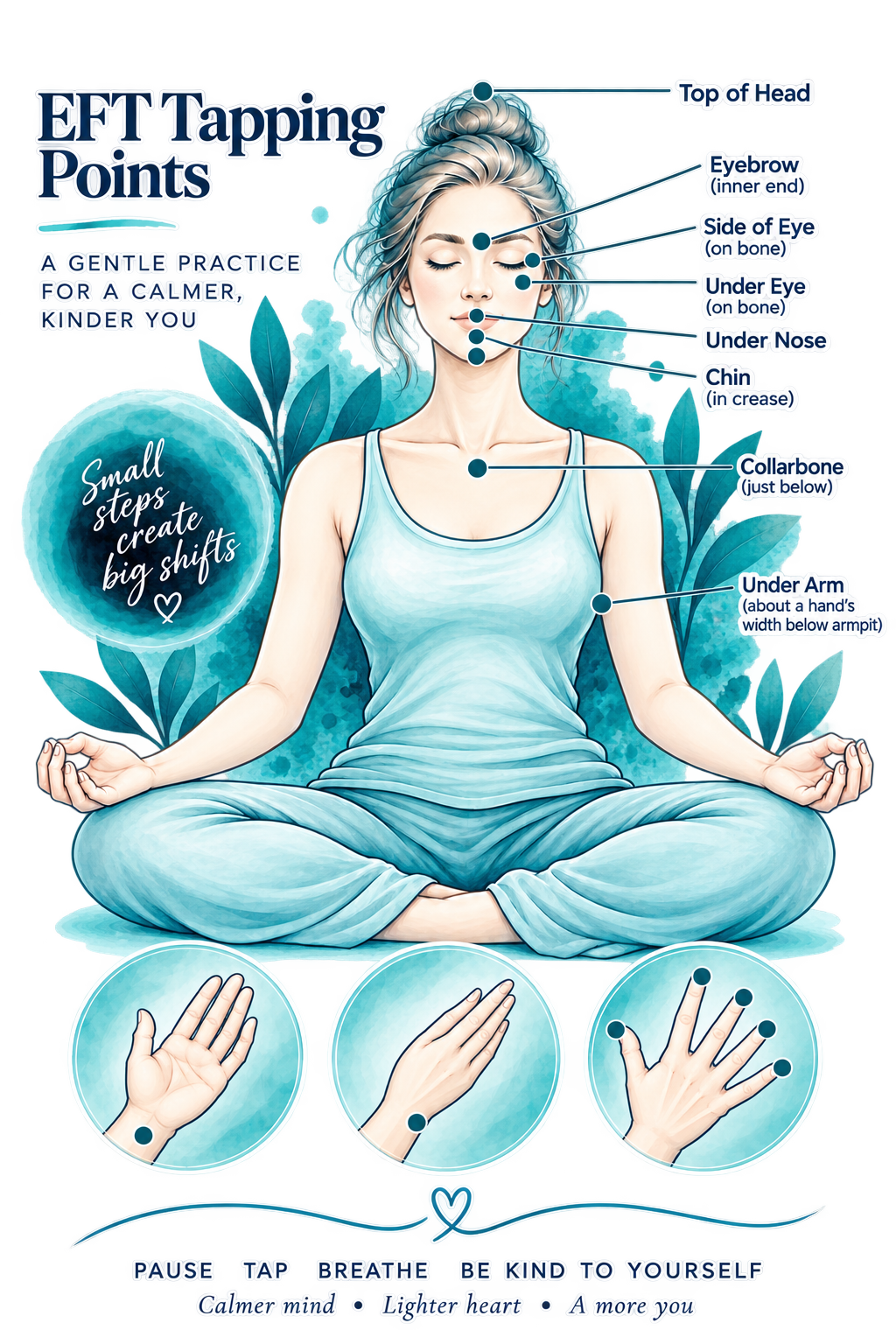
EFT – Emotional Freedom Techniques – combines gentle fingertip tapping on a sequence of points on the face and body while paying attention to a feeling, thought, body sensation, memory or situation.
The tapping points originate from acupuncture and traditional Chinese medicine, but there are no needles involved.
You don’t have to go looking for something from the past or decide in advance what a feeling means. We can begin with what’s here and gently follow what emerges.
What does EFT feel like?
If you’ve never experienced EFT before, the idea of tapping on points on your face and body while talking about how you feel might seem a little unusual. That’s understandable – it can be quite different from what people expect therapy to look like.
The process itself is gentle. You remain in control of what we explore and how much you choose to share. You don’t always need to tell me the details of an experience for us to work with how it is affecting you.
We begin with what you’re noticing – perhaps a feeling, thought, memory or sensation in your body – and tap together, gently following what emerges. We pause along the way to notice what, if anything, has changed.
Sometimes the first thing people notice is a sense of calm or settling. At other times there can be a shift in the intensity of a feeling, a change in how something is experienced, or a new thought or perspective.
Although the process can seem surprisingly simple, the changes people experience can sometimes be significant.
You don’t have to convince yourself that something has changed. You notice it for yourself.
EFT can be the therapy
You can come to me specifically for EFT Tapping. You don’t need to be having counselling with me, or have counselling alongside it. EFT can be the main focus of our work together, with sessions centred around tapping and what you would like to explore or change.
We begin with what is present for you – perhaps a particular difficulty, feeling, situation, memory or pattern – and use EFT to gently explore what emerges. You remain in control of what you share and how far we go.
EFT can also be integrated into counselling where it feels helpful, but it doesn’t have to be.
Something you can use for yourself
One of the things I value about EFT is that it isn’t something that only happens in the therapy room.
As you become familiar with tapping, you can begin to use it for yourself between sessions – perhaps when you’re feeling anxious, overwhelmed or when feelings become particularly strong, or simply when you want to pause and settle.
It can become another resource you have available to support yourself when you need it.
What does the research say?
EFT may look unusual, but it isn’t simply a technique based on anecdotal experience. There is a growing body of clinical research into EFT, including randomised controlled trials, systematic reviews and meta-analyses.
Research has explored its use with difficulties including anxiety, stress and trauma-related symptoms, with encouraging findings. As with many therapeutic approaches, there is still more to learn, and the quality and strength of the evidence varies across different areas.
Explore EFT research: EFT & Mindfulness Centre | Further research
Interested in trying EFT?
You don’t need to know whether EFT is right for you before getting in touch.
You’re welcome to arrange a free 20–30 minute discovery call, ask any questions and get a sense of whether working together feels right.